That's just some misluck: your git push is taking ages to complete. By checking it out later on, you realise you have pushed videos that do not belong there. git rm Videos/* is merely placing a curtain over a broken window: videos are still in the repository, they still make any clone über-huge.
 Take your TARDIS and go erase any evidence of your mistake before someone else clone your repository! But before doing that, a git pull is required so that you're sure you're operating on a fresh space-time.
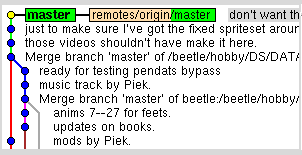
gitk
with this tool, find the revision where your Videos come from. Then grab the commit-id (sha1 hash) of the commit just before. Let's say you messed up on commit deadbeef and that cafebabe was your commit just before.
the command we want to execute on every commit between cafebabe and now is
git rm --ignore-unmatch -f Videos/*
The way to travel through time on cafebabe..HEAD to enforce that is
git filter-branch --tree-filter "git rm --ignore-unmatch -f Videos/*" cafebabe..HEAD
I bet you want to update gitk's view and explore commits to check all signs of your videos are indeed gone. Good.
Now, let's really cover our tracks:
mv .git/refs/original /tmp/refs-original-git
git reflog expire --expire=now --all
git gc --prune=nowgit gc --prune=now --aggressive
If you were lucky and realised your mistake before the push, you're now done. If you had it pushed to the master repository, you still need to push these fixes ahead:
git push -f
And if you have a second clone of the master (at home?) where the videos still exist and that you want it as clean as the master,
git pull --rebase --verbose
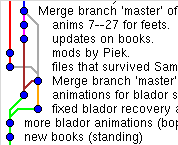 (ooh, I wish so hard it had a "--dry-run" mode. Maybe you're better to clone your @home repository, and give the command a shot on the clone first so that you can check it has no undesired side-effects. The man pages claim that pull --rebase is potentially dangerous as it may affect your history. This is precisely what I want, but if for some reason your control on the master repository is weaker (i.e. someone else could alter its state between push -f and pull --rebase), you may want to follow the manpage advice and read git-rebase manpage first.)
Thursday, February 21, 2013
cleaning up a git repository ...

Wednesday, February 20, 2013
Quelle taille de crayon ?

I have a "thread" of activity that insist on bringing life to the inkjet. Pixel art is ready, fundamental parts of the behaviour "should work", but it's not operational yet.
Par où continuer ? Les pentes supplémentaires, ce n'est pas franchement une priorité. J'ai bien progressé sur inkjet, j'ai du pixel art qui est prêt, mais ça chipotte un peu au niveau du GobScript. J'ai regardé de plus près le coup de la "corde qui pendouille" et couvert 2 ou 3 pages de formules et de schémas UML, mais pour le rendu, j'aurai certainement besoin du support 3D.
Alors, quitte à se taper la partie "3D", autant en profiter pour enfin amener le crayon-soldat sur le terrain, non ? Le hic c'est que mes dernières tentatives pour animer côte à côte Bilou et un de ces crayons n'ont pas franchement été convaincantes. Au point que j'hésite même sur la taille à donner au crayon. 40 pixels de haut, Bilou pourra sans trop de problèmes passer par-dessus. 48, c'est peut-être mieux, mais aussi peut-être trop haut pour les capacités actuelles de Bilou


Curieusement, je n'ai pas énormément de croquis de références. Dans tous, un pendat fait entre 2 et 3 Bilous de haut. Par contre, s'il est possible de passer par-dessus un pendat qui charge, mais de justesse, ce qui demande un timing quasi-parfait. L'idée étant évidemment d'encourager le joueur à se servir des dumbladors pour assommer les crayons ou de profiter d'un obstacle plus haut en bout de chemin de ronde.
Bref, le mieux, ce sera encore de faire le test: combien de fois parvenez vous à passer par-dessus le crayon, à gauche de la map avant de mourir (SchoolTest.nds)

So let's try it out. Can we clear a jump over a 3-tile-high static pencil ? Is it interesting to have Bilou jumping slightly higher when he walks(/runs?) like in Super Mario Bros ? If so, is it interesting to have Bilou unable to jump over a pendat unless he walk-jump it ?
Tuesday, February 12, 2013
Swinging Ropes in Pharaohs Return
Il paraît que les forums, c'est la "matière noire" d'Internet. Obscure, insaisissable, insondable. L'antimatière d'un blog/wiki, en somme. Et pourtant, j'adore la façon dont on peut y rencontrer des gens qui ont des intérêts proches des miens. Par exemple, Lazycow nous prépare depuis fin Mai l'exhumation ultime pour "Pharaohs Curse". De nombreuses salles, des couleurs et des décors réalistes, une pléthore d'actions, d'items et des animations à couper le souffle.
Pour sûr, son projet n'a pas à rougir des dernières sorties homebrew sur cette machine telles que Get'em, Mayhem in Monsterland ou Soulless. Superpositions de sprites, reprogrammation à la volée pour doubler le nombre de sprites visibles à l'écran, mélange entre caractères monochrome et multicolores ... tout y est! Même les boss démesurés.


Mais ce qui m'a le plus épaté, c'est cette animation que Lazycow a postée où son explorateur attrape une corde au vol. J'avais toujours classé ce genre de détails dans la catégorie "sympa, mais clairement pas prioritaire". Mais s'il le fait sur C64, je me dois de ne pas être en reste sur la DS, pas vrai ? Grimper aux signets des livres fait partie des éléments de level design que j'avais explorés au moment de reprendre le travail sur Bilou ... Difficile maintenant de me contenter d'un signet rigide même si celà faciliterait le développement.

When I asked Lazycow whether he had a tutorial on that, he keenly handed me the snippet of his source code that handles the rope action. I noted so far two sub-behaviours: the rope "above" the hanging character simply follows the shortest straight line between the hook and the hero.
for i=1 to heroheight:
s[i]=i*herodelta/heroheightdelta=s[i-1]-s[i], increasing the segment's speed so that it moves back towards the previous segment, then enforcing "integrity" of the rope by avoiding exagerated offset between segments.sin(x)=x and thus that it shortens by the amount it deviates from the straight vertical line (a fair estimate until you approach x=30°) Friday, February 08, 2013
Gare aux taches d'encre ...

Petit tour d'horizon sur la façon de le réaliser, à l'ancienne sur une feuille quadrillée avant d'aller dormir... Chose amusante, je me rends compte qu'en réalité les 2 formes d'encrier ("volant" ou "poussable") présentés ici pourraient très bien être 2 GOBs aux machines d'état totalement distinctes.
 Parmi les "petits défis techniques" posés par Inkjet, j'ai recensé le "demi-tour de plate-forme mobile", nécessitant un contrôleur adapté.
Rien de particulier pour que Bilou puisse être transporté par un inkjet, en revanche: ce sera entièrement dans le code de Bilou que ça se passera.
 Envoyer Bilou en l'air s'il est présent et lancer des gouttes d'encre dans le cas contraire ? C'est possible. Il suffit d'une zone de collision associée à l'animation "projeter". Si elle rencontre un personnage compatible (transition "found"), elle interrompt l'animation (et le projette). Les gouttes d'encre ne seront générée que si l'animation prend fin naturellement (transition "done" dans ma machine d'état).
 Pour l'encrier au sol, je devrai procéder en 2 temps. Tout d'abord, m'assurer qu'il est effectivement "solide" pour les marcheurs, qui fasse faire demi-tour aux dumbladors et force Bilou à passer en mode "pousser".
Ensuite seulement, une 2eme collision dans le sens inverse force l'encrier à se déplacer.

Checklist:
- [check] special block digits are read horizontally first, then vertically
- [oops!] 1xxx is for
"interacts with monsters""interacts also with monsters", 2xxx is for "doesn't trash graphics while removing properties""doesn't disappear when touched", but we could use "on hit [0] ()" in block description to prevent it. - [oops!] "
block 1002 {"effectively encode properties of block using digits 1,0,0,2 on the level editor and not some other funny 0x1002 value that wouldn't make sense. (block 82 is required.) - [ok] states doesn't prevent collisions to be detected.
- [fixed] decrease controller
cancannot be used as expected. - [bugfix] GameScript::content() should allow \t tabulations in cmd files.
Tuesday, February 05, 2013
Rope it up!

In my game engine, such discontinuity can be handled naturally as I can attach different control chains to the different player states.
(Note that I will consider that ropes are just an visual alternative to ladders, that do not bring significant gameplay difference -- i.e. you can't swing ropes yet).
J'aime beaucoup la façon dont Paul Firth introduit les échelles dans son tutoriel. "Rompre la continuité du gameplay". Forcer le joueur à utiliser temporairement d'autres règles de déplacement que celles du platformer, et donc l'obliger à se défaire d'une part de son "confort" de marcheur. Rien à voir, donc, avec le grillage ou Mario se déplace librement dans le château d'Iggy.
La bonne nouvelle, c'est que ce genre de dualité est parfaitement prévue dans mon modèle de "machine d'états" pour la gestion des personnages. Pas besoin, donc, de rajouter des booléens dans tous les sens et des tests tous côtés.
En outre, dans un niveau largement fourni en "plateformes à sens unique" (p.ex. un empilement de livres ;), les cordes et échelles peuvent aussi être un moyen d'offrir localement au joueur la possibilité d'aller "à contre courant". Une seconde bonne raison de ne pas se contenter du moteur de jeu actuel, donc.


Ideally, it must be possible to let the game engine align the character to the rope/ladder so that climbing animation works. As mentioned in a former post, this require the combination of the cando(F_LADDER) property on the tiles occupied by the character and dpad&KEY_UP guardian expression.
Il me faut donc un "micro-contrôleur" de personnage capable de s'aligner sur une échelle (align_flag), un capable de créer un évènement lorsque le personnage passe à un endroit où un nouveau mouvement est possible (detect_flag), et évidemment, un comportement pour monter/descendre à l'échelle. Le reste n'est plus qu'affaire de mettre le bon contrôleur au bon endroit, et à filtrer les évènement générés par detect_flag en fonction de la direction prise par le joueur.

Monday, January 21, 2013
More slopes
 J'ai envie d'avoir plus de souplesse dans les pentes que juste "45° dans quel sens?". Si ça n'apporte pas grand-chose au niveau du gameplay en tant que tel (un ennemi-marcheur en haut d'une pente garde un avantage stratégique même pour d'autres formes de pentes), ça permet de construire des niveaux plus "organiques", ce qui n'est déjà pas si mal.
 En revanche, j'ai déjà saturé le nombre de "type de blocs" dont je dispose vu ma technique d'encodage. L'idée cette fois serait de combiner le "type" (encodé par élément 8x8) avec la position du tile au sein d'un bloc de 64x16. Si ça reste jouable au niveau du moteur de jeu, ça demande un support spécifique dans l'éditeur de sprite pour "préparer" ces blocs de 64x16 contenant 16 tiles alloués de manière contigüe dans la SpriteRam (alors qu'ils sont normalement alloués par bloc de 4) puis de les disposer conformément à ce qui est prévu pour un des type d'obstacles souhaités.

Bon, je sais, ce n'est sans doute pas ultra-prioritaire pour faire avancer Bilou, mais mon petit J.l.n est né vendredi dernier, ce qui réduit un peu ma liberté d'action. Un peu de bidouille dans les éditeurs devrait donc être plus aisé que d'aller créer du code pour de nouvelles interactions avec Inkjet.
Thursday, January 10, 2013
Setting the bar

When I stumbled upon a post entitled "Platformer Enemy Design" in the newsfeed, right after I had crafted the "monster design book" out of this blog, I felt like a kid getting his Christmas present. Yet, the content was pretty far away from what I expected! The post is actually more like a call for rationale development applied to people who code monsters behaviour for games.
Juste comme je finissais le post sur les versions papier de "level design" et "monster design", je tombe sur un article d'un des auteurs de "frogatto & friends" (excellent petit jeu indie et open-source) intitulé "design des ennemis dans un jeu de plate-forme"... qui s'avère être très différent de ce à quoi je m'attendais, mais très intéressant malgré tout. Jetrel y présente une série de "pièges" dans lesquels un développeur de jeu peut tomber (liés à la conception des ennemis) et qui pourrait retarder indéfiniment sa "sortie".
Consider making a flying enemy with basic behavior that makes it fly from one X position, to another X position. In a generous, open space with no terrain in the way, writing this is trivial; [...] It seems reasonable, from a level-designer’s standpoint, that it should always work regardless of the layout; [...] So if you put it in a twisting corridor, it’ll naturally duck under the outcrops, and rise over ridges to find a path back and forth. Except actually it won’t, because [...] there is no pathfinding. There’s no AI; there’s just one, single line of code with two conditionals in it.

Le premier conseil est une variation sur le thème (célèbre) "Keep it Simplest, but not Simpler": faire le plus simple possible, mais pas plus simple que ça. En particulier, s'évertuer à créer des monstres qui se comportent *toujours* correctement, quelque soit l'environnement, est inutile. Ce qui est important, c'est qu'il se comporte correctement *dans le type de niveau pour lequel il a été conçu*. Si la BerryBat est prévu pour poursuivre Bilou dans des cavernes, il se peut très bien qu'il ne fonctionne pas à l'intérieur de la pyramide (plus labyrinthique) parce qu'elle se cogne systématiquement au murs. Inutile aussi de prévoir que Funky Funghi doive "mourir" s'il tombe dans l'encre de la SchoolZone: il n'y a pas d'encre dans son environnement. Dans le même ordre d'idées, les Applemen qui se croisent ne posent pas de problèmes dans un niveau "à la Mario", même s'ils provoquent des problèmes de clarté dans Apple Assault.

Ce qui est amusant, c'est que les pieds baladeurs de Dumblador ont justement posé des questions de ce genre il y a un mois. Je les avais codé initialement pour qu'il puissent franchir *n'importe quel* obstacle (quelque soit sa hauteur) en les faisant sauter de plus en plus haut. Au final, ils étaient tout simplement incontrôlables et finissaient par sauter tellement haut qu'ils ne parvenaient de toutes façons pas à franchir l'obstacle en question. Dans la démo de nouvel an, les pieds *escaladent* les obstacles plutôt que de chercher à sauter par-dessus. Ça me convient. Il y aura des situations dans lesquels un Dumblador assomé ne pourra pas récupérer ses pieds (en particulier si Bilou l'emporte avec lui), mais il existera aussi des dispositions de niveau dans lesquelles j'obtiens l'effet désiré: un ennemi qui prend plus ou moins de temps à récupérer selon la situation dans le niveau (autorisant des stratégies du genre "j'attends qu'il soit au bord pour l'assomer) tout en offrant un retour visuel sur le temps qu'il reste pour s'en saisir.
J'admets qu'il faudra que je garde le conseil à l'esprit et que j'en fasse une ligne de conduite, parce que j'ai une tendance naturelle à résoudre des problèmes larges. La façon dont les ennemis "marcheurs" de Bilou décident de faire ou non demi-tour en est un exemple, mais je ne saurais me résoudre à une approche "dessinée" du trajet suivi par les monstres (cf. RSD Game-Maker), car j'ai déjà pu me rendre compte à l'époque que les types d'interactions que je souhaite apparaître au coeur du gameplay (interrompre le chemin de ronde d'un pendat en faisant tomber un inkjet, par exemple)
If you do a boatload of work on an enemy to make it work in different situations, but the basic decisions the player faces are still the same, you’ve wasted your time. The basic gameplay is still the same; you’re just jumping through hoops to provide it.
Which I translate in "no matter how smart that inkjet is when it shoots at you: if you can dodge its balls just by jumping anyway, you have changed nothing". I think this is deeply connected to interplay. I'll have to push more thought into that part.
Il y a d'autres choses intéressantes dans cet article, mais là, ça fait 3 fois que ma fée me demande l'heure en 30 minutes, donc je vais lacher un peu mon clavier ...
 - +
- + 


 Vote for your favourite post


