Showing posts sorted by date for query furries. Sort by relevance Show all posts

Tuesday, June 03, 2025

Starport BBS*.as3m

J'avoue: j'ai un faible pour les sons AdLib. ça doit venir des des heures passées dans les Shadowlands et sur l'Omegamatic ... Parce que oui, la synthèse FM utilisée en guise de synthé midi, c'est loin d'être formidable, mais quand vous laissez des habitués du SID s'en emparer, ça peut donner des pépites.  Mais paradoxalement, c'est aussi ma plus grosse bête noire. 

Vous vous doutez bien que de l'Adlib, j'ai essayé d'en mettre dans mes programmes, hein. Le premier jeu Bilou en QuickBasic avait eu droit à une extension SoundBlaster qui m'avait notamment permi de jouer une petite musique de fond pendant qu'on était sur la map, au prix de ruses de sioux. Mais voilà, si le son par défaut était potable pour faire des petits jingles (remplaçant ceux joués au PC speaker), on était loin des bandes sons même de Jill of the Jungle. J'avais essayé de me faire mon petit programme de configuration de sons, mais il faut bien reconnaître que la seule chose que je comprenais, c'étaient les niveaux d'attaque, decay, sustain release, concepts que je connaissais déjà de l'époque du C64. Sauf que bah ... ça ne donnait pas grand-chose: je n'ai jamais réussi à en tirer aucun son intéressant. 

Puis (?) le RSD game-maker a fait son apparition chez nous ... il nous suffisait de trouver des fichiers .cmf pour avoir de la musique dans nos jeux. Elle était adlib. Il y avait des morceaux plus ou moins réussis dans le pack de base, mais surtout, il y avait des .cmf dans Jill of the Jungle, Hocus Pocus et pas mal d'autre titres. Mais point d'éditeur de cmf, pour "Creative Media File"...

Mais comme on pouvait le prévoir, au bout de quelques jeux, le côté "Piet the Craker-boy" de mon frangin a cédé devant le côté "MC-Piet / Cyborg Jeff" qui s'était trouvé un modtracker. Chiper les musiques d'autres jeux pour les mettre dans nos jeux ne suffisait plus (le fait que le magazine PC Fun ne les ait pas redistribués a sans doute joué aussi). Comme le premier modtracker qui a bien voulu tourner à la maison était livré avec un fichier .TXT qui expliquait le format de fichier .S3M, ça a été le début de la grande aventure player soundblaster ... mais ça, c'est une autre histoire.

Le déclencheur pour l'histoire qui nous intéresse, c'est au moment où j'ai trouvé la description du format de fichier .mid et comment un .cmf est en réalité un .mid avec des réglages de carte adlib pour les instruments concernés en en-tête de fichier. Il ne m'en fallait pas plus pour commencer à envisager un programme (en assembleur, évidemment ^^") de conversion aS3M->CMF qui nous aurait permis de ... per ... mis... de ... (pause dramatique) conquérir     le monde!

Sauf que bon ... de nouveau, je n'avais pas grand-chose à mettre du côté "instruments". Si seulement j'avais eu les fichiers de Purple Motion (ne manquez pas la fonction 'player online' :), ces .as3m qui reprennent aussi les paramètres des oscillateurs, ces chiffres hexa sur les lignes "mod"(ulator) et "car"(rier), j'aurais pu les réinjecter dans mon vieil outil BASIC, non ? 

basschordscounterlead
chordlead1lead2lead3

Qu'est-ce qui change aujourd'hui? Eh bien ... on peut trouver des vues oscilloscope de certaines des musiques du répertoire FM de l'âge d'or. Et si je ne sais pas encore en dire "ah oui, c'est avec un LFO et un LPF", au moins, je peux voir quelles ondes de base ont été utilisées pour quel type de son. Par exemple pour un titre de Fury of the Furries

Et dans "The Alibi", à l'exception du son pour les accords, tous les sons se modulent au fur et à mesure. Et la façon dont ça se produit sur la vidéo me laisse penser que ce n'est pas une conséquence naturelle des paramètres de modulation choisis: un des paramètres (le volume du modulateur, à en croire @laamaa). Mais sauf erreur d'interprétation de ma part, certaines modifications de la forme d'onde au cours du temps peuvent donc être simplement liée à l'enveloppe ADSR du modulateur.

J'aimerais donc tester 

Mais à quelle fin ? Parce que bah, j'ai plus de carte Adlib sur aucune de mes machines. Alors oui, la version Linux de SchismTracker permet de les rejouer ... il y a des générateurs de sons adlib, mais ils sont basés sur des calculs en virgule flottante intensifs, chose que la NDS n'a pas...

On pourrait souder un chip FM sur une cartouche GameBoy ... ça serait sympa et le port gameboy à ce qu'il faut pour en récupérer le son ... mais bon, je ne suis pas Natalie, moi ^^"

Bref, reste l'idée un peu farfelue d'un sketch-a-sound pour DS qui aurait des fonctions de morphing frame par frame ... peut-être que ça rendrait... ou pas ...

Wednesday, April 30, 2025

Puddlehead splash

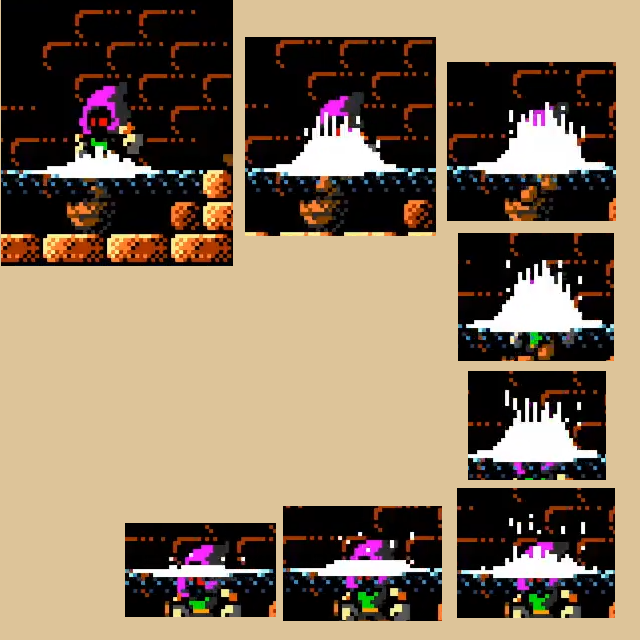
There's one thing I still miss in my water implementation, and that is splashes. The most beautiful waterfall will fall flat if the water pool doesn't acknowledge you've changed physics by a nice splash of pixels.

I've gathered a few references in my pixelstudies, and this one comes from
puddlehead-creations.itch.io
The video was initially intended to demonstrate how surfaces in GameMaker can be used for palette-lighting  in CinderHoodGame, but what caught my attention was those simple an efficient splashes, which I wanted to pixelstudy.

Un beau splash! Voilà ce qu'il manque à mon petit coin aquatique... Et des beaux splash, vous pensez bien que j'en ai croisé 2 ou 3 depuis que j'ai dessiné la cascade. Celui que vous voyez ici apparaît avec l'autorisation de Puddlehead Creationset a été patiemment extrait à l'aide de VLC d'une vidéo présentant un nouveau shader pour leur jeu CinderHoodGame

As often, such material is posted as a video, so I had to frame skip to get the different steps studyable. May I  call this family of splashes "noisy gaussians" ?

There are two separate animations, depending on whether you splash into the water pool or out of it. 

In both case, I'd first animate the big white part and only then add those noisy spikes and make them turn into "independent droplets" as the splash collapses.

Ne pas hésiter à faire deux animations, une pour "plouf dans l'eau" et une pour "sphlash hors de l'eau" ... partir d'une courbe en cloche d'écume blanche, ajouter des déviations pour le haut ... attendre le moment où l'eau retombe pour ajouter des goutelettes qui suivent leur chemin ... voilà ... à tester.

En comparaison, l'eau de Super Mario World fait un peu pitié ... une couleur unie, une surface statique, un splash qui recycle le nuage de poussière, selon moi ... Par contre, je note l'idée intéressante de faire apparaître au moment du splash des petites bulles qui remonteront à la surface ;)

In comparison, SMW's water is very cheap, with static line, solid blue, unconvincing splash recycling dust sprite ... but it had the good idea of spawning bubbles under you. Rayman's sprite is beautiful, but low framerate and oversized for Bilou's weight. Fury of the furries reused their particles engine but imho could use some fine-tuning... And Hydrocity used something too blast-ish.

edit: One more splashy video posted by Puddlehead creations, just in time to replace the one I used for the snapshots ^_^

Thursday, April 24, 2025

"Why am I doing this?"

It's not unusual to ask yourself the question among indiedev. What struck me is that the question was raised this time by someone who's been interviewed by Pix'n'Love and makes games with his son: Dale Coop.

There are moments when I wonder, “Why am I doing all this?” It takes so much time, few people care, and it brings nothing in return. The majority of people don’t even know it exists. Should I just move on to something that makes more sense for my life and family? That’s where I am today 😔 -- Dale Coop

I know that feeling. I relate it to those time where you feel the urge to eat, but nothing you eat seems to quiet it. Because actually, I need to eat something different (sometimes more fruity, sometimes more crunchy, ...) Sometimes gamedev is satisfying, sometimes we need something else.

What tend to make me wonder "why am I ..." is the overall dsgametools approach. 20 years past the introduction of the NintendoDS, and despite my first game on the system is now about 15 years old, none of my relatives have really picked up the tools and start making their own PPP games with them. It is heartwarming to read veteran artist say "your tools are perfect and tailored to your needs", yet

  • basic *EDS tools apparently feel repulsive to friends and nephew and will be lacking to professionals
  • conversion tools are so tricky to use, you'd better consider them inexistant
  • I've got nice IRL chat sessions with my son about the game design overall, but pencil drawing is none of his hobbies so I'm left with all the job anyway
  • mixing script and C++ code in the engine doesn't feel that useful when I'm the only developer anyway. It makes many debugging sessions more complicated that they should because you can't really single-step the GobExpressions

I've got something running, but it is far from perfect and it gives me the feeling that I've made my own life overcomplicated. Nobody would use scripted state machines in a platformer. Or if you really want editable behaviour, you'd go for something like Fury of the Furries. 

Nobody ?

Well, I've encountered some github project to decompile the original Rayman title on PSX. I was looking for the code of that tricky-to-beat bandlands bug, and I got intrigued by some of the GO_SPEED, GO_LEFT, etc. you could find in the "top" function DO_MIT_COMMAND. No reference to that anywhere else in the codebase. I was also puzzled by the "skipToLabel();" calls. Digging through references, I end up with just one big "load" function filling all the commands together with other loads for the level... So they're not just some data part of the game engine.

I couldn't find anything like "Rayman Level Format" as I hoped, but I found Ray1Map ... the website that pretends to be a Rayman 1 level editor, and that's nearly as good as far as I'm concerned.

And there, we can view the commands for each individual enemy in the game. Some of them will be delivered to per-enemy handler (like LEFT % and RIGHT %), many will affect variables that those handlers can check and manipulate (especially enemy state), but there's also a whole set of flow control instructions for loops, branches, and even subroutine calls. And as you can see, the programs are already quite sophisticated. But that was used, and not only by that game (and its numerous ports), not only for other Rayman games (like the designer kit or the Junior series), but for dozens of unrelated platformers until the GBA era... or so does the Readme.md file suggests.

So well ... let's say that for 32-bit consoles, that approach makes sense, and recreating a game engine that deals with such abstract code at runtime isn't a bad idea. I just need to give myself better tools to address the debugging aspects... like presenting the whole thing as the debugger for a virtual machine that does not exists ?

Saturday, March 15, 2025

Dans les .DAT de Fury

J'aurais préféré pouvoir dire "dans le code", mais à défaut,  moddingwiki sur shikadi.net a pas mal d'info sur la structure des niveaux d'un de mes jeux fétiches: Fury of the Furries. On y apprend pas mal de choses qui différencient le code du genre de code que moi j'aurais écrit. Comme ce tableau de 5 entrées pour "une zone d'eau" puis 5 autres "téléporteurs". Les concepteurs du niveau devront se débrouiller dans ces limites. Les zones sont forcément rectangulaires, aussi. De mon côté, n'importe quelle zone de 8x8 pixels du niveau peut devenir de l'eau, mais ça aura demandé pas mal d'efforts de développement.

C'est presque encore plus contraignant que les lignes de code BASIC que j'écrivais dans les années '90. Mais avec cette structure statique, on *peut* se faire un éditeur de niveaux et éviter de devoir lancer le jeu après recompilation pour vérifier que les coordonnées correspondent bien à ce qui est prévu. Et le nombre de zones reste suffisamment faible pour ne pas ralentir l'exécution ... même probablement plus efficace qu'avec une liste dynamique puisque les emplacement en mémoire de cette liste sont connus dès la compilation.

There are days where I'm proud of the game engine I've crafted for Bilou on DS and days where I can't help feeling ashamed for how much overhead it carries for things that would have been made so much simpler in the 16-bit age. So from times to times, I go for another hunt on "how 16-bit games stored their levels" in hope that it would teach me how the engine manipulates them.

I knew Fury of the Furries had a level editor. We even have some icons and UI elements in an LBM file shipped with the game. For years, that's been all we had, but now the moddingwiki also features a description of .BIN files for each level in the DAT/ directory. You can see there that there had been some agreement between coders and designers that 5-{anything}-ought-to-be-enough-for-everybody. 5 exits. 5 teleporters. 5 regions where Green's rope wouldn't attach. 5 pools of water ... within each entry, you just find coordinates of a rectangular area. 

I used to have IF XX > 150 AND XX < 270 AND YY > 160 THEN die() in my QBasic edition of Bilou ... well, this is more or less the same. Except you don't get a script line, but you do get a tool that can adjust those coordinates with the mouse and have the engine load them precisely where the game logic will scan them. In comparison, my current engine will instead provide a get_tile_type(x,y) function that looks up a value in a phys_level_map[WIDTH/8][HEIGHT/8] and then let the state machine adapt from that ... where Fury.c could have if in_water_area(furry.x, furry.y) swim(furry);

Of course, that puts a strong limit on how many things you may have in every level, and thus on the size of those levels. It works fine with Fury because levels are quite small, although you may stay longer in some of them than in a Super Mario Bros level. This approach wouldn't have worked for Badman II-styled level, nor for a metroïdvania level design ... But for the maps my brother had drawn for Bilou's Adventures, even the 10 ennemies per level limit could have worked.

Un autre élément intéressant: la façon dont les blocs destructibles sont gérés. Vu la palette réduite, il n'y a pas de "portion partagée du tileset" ici.

Certain tiles in the image file have special meaning.

The tile at 0,1 is a coin. If the player touches this tile in the level, they will gain a coin, and the tile will be swapped out for the tile at 0,0 which is always empty.

The tile at 0,2 is an extra life. If the player touches this tile in the level, they will gain an extra life, and the tile will be swapped out for the tile at 0,0.

The tile at 0,3 is a time extension. If the player touches this tile in the level, they will gain an extra 30 seconds on the clock, and the tile will be swapped out for the tile at 0,0. 

All the remaining tiles on rows 0, 1 and 2 in the map are destructible tiles.

Par contre, certains objets doivent systématiquement être à certains emplacements, comme la pièce (coordonnées 0,1), l'image à utiliser à sa place (0,0), les animations à afficher entre les deux. On a droit à tout une ligne d'images que Fury Rouge pourra grignoter, et les deux lignes en-dessous serviront pour les blocs un peu abîmés et très abîmés. Tellement plus simple que mes "mapanim" ^^"

They also had an interesting approach for animated tiles: the top rows of the tileset pictures (7 or 8 of them) have special meaning, as well as a few more on the leftmost column. You'll see the details in the quote above. An interesting alternative to the hard-coded crumbling floor logic of 8-bit titles like Manic Miner, if you ask me. It requires a good pre-production brainstorming to decide what sort of things we want/don't want in the level, but at least the level designer and the graphist are free to make anything crumbling / chunked by Red as they see fit without having to bother the coders with One More Change.

Mais ce qui m'a le plus surpris, c'est le nombre si faible de "sprites" autorisés dans le niveau combiné à la quantité d'informations associée à chaque sprite. Imaginez: seulement 10 ennemis par niveau !? Mais la raison, c'est qu'il n'y a pas ici "d'ennemi partagé" non plus: pour chaque ennemi, on définit les zones qui le déclenchent, les flots qu'il active/désactive (les interrupteurs et les ennemis sont donc gérés de la même manière). ça explique comment on se retrouve avec des comportements si différents pour le même visuel de monstre ... mais rien qui ne se comporte comme un koopa (avec un déplacement identique d'un bout à l'autre du jeu).

One even more interesting thing is the way sprites are handled. There are few of them per level, but they are given over 1600 bytes each. All the switches and doors and falling blocks that you push and then move into place, all this is achieved with those 10 sprites that can have up to 10 state each in the level. 

Et ce que vous voyez là ne fait même pas directement partie de la structure "sprite", c'est un des 10 états associés à un des sprites, avec leur propre vitesse, leur propre type de déplacement, 


10 states is rather few (pendats in SchoolRush have nearly twice that amount) but what makes it brilliant here is that these are no koopa-like sprites. Their state machine is level-specific and instance-specific. You don't craft a mummy that will turn back at the edge of any platform, you have an editor that let you say *this* mummy will cycle horizontally between *here* and *there*. Same for the falling bricks. or the doors.

RSD Game-make state machine could only have one "next state" for each state. Pretty limited. Here there are at least 8 state transition conditions (most of them being triggers), some about "when that position is reached", other "when that water area reached that level", etc. And yup, you can "name" a water area or another sprite, or even a "current" area (flowing air or water) and activate/deactivate that when your sprite reaches a give state. 


Even the elaborate level 2 of the Pyramid could be explained with pre-defined path alternating "move horizontally" and "falls & bounce", with triggers so that the rocks start falling... there's not even need for a multi-state orange box as I depicted: there is no "shooting" of rocks, just a stock of 3 rocks rolling left and 3 rocks rolling right, and each could unlock the next one when crossing some predefined trigger.  

(PS: j'en profite pour introduire le tag "level data", et attendez-vous à ce que j'essaie de trouver l'équivalent pour d'autres jeux)

Friday, March 14, 2025

#20games

Bon, il y a 20 jours, j'ai décidé de suivre l'exemple de Sverx et d'essayer de poster chaque jour "un jeu qui m'a marqué". Je l'ai compris au départ comme "qui est une de mes sources d'influences dans les jeux que je conçois et réalise ... on y trouvera donc pas Link to the Past, même si c'est à son donjon des glaces que je repense chaque fois que je dois trouver la détermination d'envoyer un recommandé ou de renvoyer des couriers administratifs d'un bureau à l'autre du même bâtiment en passant par ma boîte aux lettres ^^".

J'avais dans le passé déjà voulu participer à un autre challenge du genre puisqu'il y avait jusqu'à hier un tag "10 games" avec 3 posts ...  Croyez-moi si vous voulez, le plus difficile aura été d'attendre chaque fois 24 heures avant de parler du jeu suivant ^^".

I've followed Sverx's example and try to identify 20 games that have been most influential to me as a gamedev. Having to wait for the next day before picking the next game turned out to be one of the trickiest part of the challenge to me ^^". The challenge also said "no explanation, no particular order", but it turns out the first four I picked were among games that I go back for reference very often.

Le challenge disait "pas d'ordre particulier" (avoir Goodbye Galaxy en #1 ne veut donc pas dire qu'il s'agit du meilleur jeu ou du plus important), et surtout "pas de commentaire". Mais sans grande surprise, j'aimerais maintenant revenir sur chaque choix et contextualiser.

"Commander Keen in Goodbye Galaxy", donc, qui a été _le_ jeu utilisé par mon frère pendant qu'il dessinait les premiers niveaux de Bilou. Sans oublier les imports aux monstres de "Secret of the Oracle" pour les ennemis de la Green Zone. Il est probablement aussi parmi les jeux dont j'aimerais le plus mettre la main sur le code source. Même s'il y a les sources de "Keen Dreams", le moteur de GG est plus abouti, ça se sent manette en main...

Some of the games I mention on this blog are so influential they even get their own tag in the cloud! That's the case for Commander Keen, the game that formatted my brother's level design and monster rooster, but also for Fury of the Furries, where *I* draw inspiration during so many levels revival and where I've truly learnt pixelart. 

"Fury of the Furries", que ce soit les graphismes, les musiques, le thème, le level design, ce jeu revient tout le temps dans mon esprit dès que je travaille sur mes propres jeux, donc bin ... évidemment, c'était le n° 2. Lui aussi, j'aimerais sacrément tomber sur son code source... la physique de l'eau, du sable, la corde ... vraiment curieux de voir comment les gars s'y étaient pris. (note au passage: il y a toujours le projet FuryStudio à étudier et les infos sur shikadi.net ). C'est aussi le premier jeu que j'ai pu utiliser comme référence pour le pixel art vu que tous ces graphismes étaient des .LBM.

Vient ensuite Prehistorik 2, qui reste une référence pour moi en matière de bonus, de cachette ... et de comment faire une démo d'un niveau capable de captiver une bande de gamins/jeunes pendant tout un après-midi. Comment Bilou.BAS faisait tomber les pommes pour le décompte du score à la fin du niveau ? Prehistorik 2. Comment le niveau-anniversaire essaie de vous pousser à faire un 100% sur un unique niveau un peu corsé quand-même ? Prehistorik 2. La révision des éponges pour les pendre au bout d'un fil ? Encore prehistorik 2. Lui ... trouver son code ... je ne sais pas trop. Ce serait peut-être un sacré travail de l'étudier si jamais il faisait surface, vu les stratégies "tout assembleur" si chères à M. Zmiro ... Mais on a toujours le site mine.nu et sa page sur le format des niveaux. (Il y a une réécriture SDL2 en C, cela dit ... )

The next two may not have their own tag, but their impact on game mechanics and how to make a compact game interesting over the long run are still fundamental. They are also two of the games for which I'd definitely like to see the source code, and figure out what design choice the developers have taken.

Et Pharaoh's curse. Il a beau être simpliste au regard des précédents, c'est peut être le meilleur exemple pour moi de rapport qualité de gameplay / quantité de contenu. Ceux qui lisent ce blog depuis assez longtemps n'auront pas manquer de noter que je finis régulièrement par revenir à des mécaniques tirées de ce jeu C64 ... et j'espère toujours voir débarquer la version remasterisée de notre ami Lazycow ... Notez que pour ce jeu-là, le code source, c'est de l'assembleur, donc plus facile à reverse-engineerer. Et quelqu'un s'y est déjà attelé.

Thursday, February 13, 2025

Hang on!

It's one of the key mechanics I'd like to bring into my new game: being able to catch hanging things and hanging as well. It was a fun move in Commander Keen, it was amazingly expanded in Fury of the Furries and Mickey Magical quest ... And last week-end, I went on to try and get it prototyped.

I started with a summary of how Bilou can hang below spongebops in School Rush ... something we don't see a lot in the blog, mostly because Bilou is supposed to *ride* the sponges, not hang under them. Hanging was added as an "else" branch of another "else" branch:

when you hit the "HANDS" button mid-air, Bilou does a roll move trying to grab what's nearby. that is AIRGRAB state. The original idea was to test what was *below* him and either pick-up a dumblador or ride a spongebop... but the move shows the hand grabbing in front and rear directions as well ... so it would feel natural that Bilou could grab a sponge even if he's on the same horizontal line, like in the sketch on the left. Yet, snapping Bilou on top of the sponge from this location felt glitchy.

Bon, j'ai un p'tit Bilou suspendu sur une page de mon cahier-agenda depuis le début 2024 ... j'en ai un autre sur la bannière du blog ... je crois que l'appel du pied est assez clair: il serait temps de prototyper un peu ça, d'autant que cette fois ci, ce ne sont pas les coins de niveau où s'accrocher qui manquent dans le livre-secret-du-level-design.

Et pour "commencer simple", l'idée était de faire subir à Bilou le comportement des éponges. tout en réutilisant un des états codés pour l'interaction avec les éponges: rester suspendu (la feinte). Chose qui m'a tout de même demandé de me replonger dans pas mal de gobscript, parce qu'à la base, il est prévu que Bilou s'accroche *par-dessus* les éponges, et pas qu'il pende en-dessous. Le côté "pendu" n'a été rajouté que dans les derniers 20% du projet, entre deux séances de playtesting parce "bin, oui, c'est vrai au fait: pourquoi Bilou ne pourrait-il pas rester suspendu s'il était trop bas pour escalader l'éponge au moment ou la joueuse a appuyé sur (B) ?"

So instead, Bilou will enter AIRHOP move, getting an automatic double jump and automatically tracking the sponge's position. That feels fairly naturally when playing, that gives you a sort of "fair second chance" but it might fail anyway: you may fall below sponge's position again without having reached the "riding spot", with no hope of catching up. and *that* is the time when we finally switch to HANGING. 

There will be other objects to hang to in the game, especially bookmarks, vines, and the like. Some of them could be entities like spongebop (maybe moving a bit less), but sometimes it might also be nice to have tiles you can hook to. I have code to make some tiles react to collisions with the player, but that was not enough: the hitboxes used to detect spongebop explicitly search for baddies. And because I'm testing 3 areas over the course of the animation, I'm out of options to also test for friendly areas (which has been the case for all pick-ups so far ^^"). But hitting a tile can trigger an animation, and it can spawn an entity with proper hitboxes so that Bilou could hook to *that*. You couldn't really hook to a tile, anyway, because the BlockArea created during the collision test is immediately recycled, so you could not attach to it. 

Mon idée était ensuite d'utiliser un type de bloc spécial pour servir de point d'accroche, et d'aller "poker" quelques blocs de ce genre à des endroits bien sentis de la map "green" de la démo. ça non plus, ça n'a pas fonctionné comme j'espérais. Entre autres parce que quand Bilou cherche à s'accrocher à quelque-chose pendant sa pirouette-en-l'air, il cherche parmi la liste "EVIL" ... et les blocs interactifs, eux se présente automatiquement comme des "HERO".

Bon, ce n'est pas bien grave: puisque je voulais que Bilou s'attache au point d'ancrage, il fallait de toutes façons que j'introduise un GOB (game object) généré à partir du bloc spécial, un peu comme les scintillements qui suivent Bilou quand on ramasse un smiley bleu. Ce gob pourra être dans la liste que l'on veut. Pour éviter qu'on ne génère des quantités ridicules de gob-points-d'ancrage, on va (enfin) utiliser une animation de la map elle-même pour désactiver puis réactiver les propriétés du bloc pendant que le gob est présent. Exactement le comportement des blocs-question de SuperMario quand on les coup-de-boulise.

So the plan was the following: a new special block that would react to GRAB action. When that happens, it trigger the animation that actually leaves graphics untouched (with "spr0 ffff") but turns the physical tile into "plain fall-through" for 5 frames, and then restore the tile as "block 07" (thus interactive) again. Quite the kind of thing that SuperMario question blocks do on a daily basis, actually.

(It turned out meanwhile that using sprite 'ffff' did not work as intended, so I ended up adding a bbox statement to that animation -- effectively making it a special 8x8 tile rather than a 16x16 special block -- and fixed the code that plays mapanim so that "props" instruction is executed immediately rather than cached until the next "spr0" instruction)

anim9 spr:2 {
   spr0 7      # visuals for the "tile replacement",
   delay 5     # here just a Bilou hand ...
   done
}

state63 :anim9 {           # behaviour for that hand :
   using freemove          # just stay there, 
   area 0 (0,0)-(8,8) 1010 # accept GRAB hits.
}

state62 :anim9 {   # should have been the persistent state when Bilou hooked...
   using freemove
}

state63->state62 on found 0 [wc $1010 ?] (t) # detecting the actual hook-up hit
state63->nil on done                         # and disappear otherwise

using shgob(state63 is e:=1:6) as 6          # a special action to spawn the hooked hand
                                             # oh ... and it's an evil hooked hand.
block 06 {
    is gndhook "ff3c7cfebe2a2a00"  # the special tile 
    area (0,0)-(7,7) 1010          # will also detect GRAB hits
    on hit [t] (x6) :anim6         # and the 'x6' will invoke shgob registered 'as 6'
    props fc0
 }

That should have done it. I could see the hand showing up, and getting away, but I couldn't ever hook to it. I couldn't get an evidence of why it failed, but I believe it is rooted to the fact that bilou's own bbox must overlap the tile in order to trigger the "on hit" transition. but since all the hitboxes with the GRAB flag tend to be off-center, the second collision (with state63 entity) doesn't occur because there's no overlap.

Alors oui, je vous balance le script directement dans le browser. Parce que ça ne fonctionne pas. Enfin, après avoir corrigé la gestion de l'animation pour ne pas dépendre des changements d'affichage (qui expliquent le bout de terre manquant dans le screenshot là-haut), ajouté une "bbox" à l'animation (pour que le code sache qu'il ne doit manipuler que 8x8 et pas 16x16), je finis par avoir un objet qui est créé tandis que le bloc devient inactif puis se réactive ... le hic, c'est que il faut pour ça que le "corps" de Bilou soit en contact avec le bloc interactif alors que ce sont ses *mains* qui vont essayer de l'attraper. Et la zone à attraper est réduite à 8x8, de toutes façons mal positionnée... bref, je n'y arrive que 1 fois sur 5-6, donc le joueur n'y arrivera pas.

Il vaut bien mieux que je me décide à dessiner un graphisme dédié (une racine ?) et que je fasse juste un GOB dédié... il y aura des import/exports mercurial à faire ... 

At some point I thought "hmm. I'll just have the little tile be a 8x8 hitbox in the middle of a 24x24 special box, that will do the trick", but it wouldn't work either: that 24x24 region around the corner of a pillar (for instance) would have "jump-through ground" on one tile, and "air" everywhere else... how could a single "props" instruction fix that ? okay, I could introduce "props(-1,0) fc4" to change one specific tile of the block but that sounds like the coding equivalent of "just stab me now" ... 

So, likely, I should forget about that "hook to tile" thing, accept that there's very little hookspots in the Dreamland levels anyway and kickstart my NDS to draw some root sprite in green.spr ... 

Wednesday, November 20, 2024

guest star: François Rimasson

C'est une histoire qui avait commencé mi-février 2021 avec un tweet ... une capture de vidéo pendant un lets-play de Fury of the Furries qui me fait prendre conscience que "#infinitepyramid hints from #furyofthefurries: make sures the spikes stand out." Et là, j'ai un François Rimasson qui répond

  • I did all the graphics in 1993

J'enchaîne: You did a wonderful job, then. It has been my first good reference to get into pixelart. Huge thanks!

No kidding! I was already studying it in 2006 before I made my first NDS homebrew. And I was still using it last year.

Je dirais même que si "Badman II" a pu avoir des graphismes entièrement originaux (pour la 1ere fois), c'est grâce à l'étude des palettes de couleurs du désert et de la forêt de Fury. Donc Super-merci ^_^

Je le réaborde quelques semaines plus tard:

Tiens, à propos de Fury of the Furries, il y a ~10 ans, j'avais fait un petit test avec une de tes planches de décor pour illustrer mes outils (homebrew) de création de jeu sur Nintendo DS. Je n'étais pas allé plus loin vu que je n'avais pas les droits dessus.

Là (Mars 2021) mon gamin a l'air d'avoir bien accroché au "let's play" du jeu donc j'envisage de quand-même refaire une conversion aussi du personnage principal pour qu'il puisse s'entrainer le temps que papa ait terminé sa pyramide à lui.

est-ce que j'aurais ton autorisation de rediffuser ces graphismes au format NDS avec mes outils pour un tutoriel, ou est-ce que je garde ça dans le cercle familial ?

Et François de répondre:

  • Oui, bien sûr, fais-en ce que tu veux, c'est tellement vieux, et si quelques personnes peuvent s'amuser avec ... je n'ai plus les planches de sprites originales.
  • Je suis content que ça te plaise :)

J'ajoute : bin le côté facile avec Fury of the Furries, c'est qu'on a l'ensemble des fichiers .LBM directement dans le jeu. Evidemment, il y a peut-être des planches de pré-production que je n'ai jamais rencontrées.

Et donc on s'y met ... 

6 mars ... "oh birds! @F_Rimasson put so much pixels per spritesheet in Fury of the Furries that it used a buggy part of my conversion scripts that had never been used before ^^"

7 mars ... Hopefully, when you strip out the 'mask' sprites and re-align the sprites that were past the 'checkered' barrier, we're back to an acceptable amount. Actually, it would be perfect to illustrate UsingSprites::granularity.

8 mars ... I was about to suggest that 16-pixels and 4bpp sprites might be an Amiga sprites constraints, but it looks like Amiga sprites were actually 2bpp (stashofcode.fr/afficher-sprit), and likely did not need those mask pictures.

Bon, après ça, j'admets que les interactions ont été plus anecdotiques, avec quand même une phrase qui m'aura inspiré du monster design pour la castle zone:

  • Il ne faut pas confondre un fantôme asperger et un spectre autistique

ok, c'est décidé: si je mets des fantômes dans ma zone des châteaux, ce seront des fantômes de légumes. des citrouilles, bien sûr, mais aussi des fantômes asperges qui te crachent de l'ectoplasme dessus.

Friday, May 17, 2024

Goodboy Galaxy

I owe you a presentation of "Goodboy Galaxy", an indie exploration platformer for the GameBoy Advance released for the 20-years anniversary of the device. I heard of it while following developer hot_pengu on twitter (since 2015!) 

The game has high-quality pixel art graphics that perfectly fit the theme of "stranded on an alien planet" and super-smooth animation. To be honest, the animation is so rich that it feels like the artist did not have to worry about technical limits at all.

I don't own the game yet. I haven't decided whether I'd rather run it on a true gameboy or wait for a Nintendo Switch port ... having my GBA power supply lost somewhere in house mess does not help deciding ^^". But I played the free demo a few times, the first being in September 2021 during the kickstarter campaign (which was completed in a mere 8 hours).

Original jam (Goodboy Advance) was in Dec '18, then we (very slowly) worked on a demo of what a full game could look like (Chapter Zero) which we released I think in May '21, then we spent a few months working on a Kickstarter campaign before finally starting the full game.

precised hot_pengu when I asked. I admit that the name's pun on Commander Keen's title "Goodbye Galaxy" created some expectation, but it's not that kind of exploration.

Voilà deux fois qu'il est question de "Goodboy Galaxy" sur ce blog. Je voulais que la 3eme en soit une présentation officielle. Idéalement, je l'aurais faite après avoir passé un certain temps sur la démo (au minimum), voir après avoir joué au jeu complet. Mais voilà: ce monde n'est pas idéal ...

Goodboy Galaxy est sorti en 2023 sur Gameboy Advance après 4 ans et demi de développement en indé. La campagne Kickstarter de 2021, c'était une folie et le budget espéré était disponible en 8 heures à peine. Je suivais déjà le développeur depuis un moment, mais plus occasionnellement que ce que je n'ai fait avec le dévelopement de CyberShadow ... Vu le jeu de mot sur "Goodbye Galaxy", la 2eme aventure de Commander Keen, je m'attendais à un gameplay qui serait à Keen 4 ce que Duck Tales est à Megaman ... Mais non. Le jeu qui s'en rapproche le plus dans ma mémoire, c'est Pharaohs Curse.

Low jumps (1 block), respawning one-way elevators, klap trap monsters, wrapping map ... I had a reminiscence of Pharaohs Curse during my first attempt playing the demo, and the author confirmed it was one of his references.

There are some sections where you have a bit more freedom of movement (2+ blocks, and double jump)  ... that is when your jetpack hasn't been stolen by a weird portal. Your (auto-regenerating) shield and blaster may also be stolen by other portals. If there is a way to tell what the portal will do before taking it, I haven't figured it out.

Cette impression, c'est principalement aux phases d'exploration sans le jetpack que je l'attribue, mais il y a aussi quelques rencontres qui y contribuent. Les générateurs d'assenceur unidirectionnels, par exemple, ou ces machins qui sortent du sol pour vous gober avec un léger retard (heureusement!). C'est que hot_pengu a adopté une approche plutôt inattendue où on commence l'aventure avec tout son équipement (blaster pour tirer, bouclier auto-régénérant et jetpack), mais on rencontre ça et là des portails à sens unique qui nous privent d'un de ces éléments pour un portion du niveau. Ajoutez à ça un level design où vous vous retrouvez tout à gauche du planétoïde si vous allez tout le temps à droite, et vous comprendrez qu'on finit par être un peu déboussolé... 

I must admit this approach of taking your equipment away and then giving it back to you in almost every level is quite unusual, if not unique. The closest I can think of is the "give/take color" doors of Fury of the Furries, although it doesn't affect that much the core gameplay. There have been things like that in Rayman, too, but that was part of the game's ultimate challenge, not part of every level.

Saturday, April 20, 2024

The first push

J'avais un joli projet pour le niveau 1 de la Green Zone: si le joueur est arrivé à la porte sans la clé, il pouvait libérer l'eau d'un réservoir et s'en servir pour remonter plus haut dans le niveau rechercher la clé manquante. Et pour décider si l'eau est là où pas, j'envisageais un mécanisme-à-la-fury où on pousse un bloc pour lui faire un passage.

Le hic, c'est qu'on est dans le niveau 1-1, là, et que ce sera aussi la première fois que le joueur devra pousser quelque-chose. Est-ce que je ne risque pas de reproduire le problème de la craie des 20 ans où une majorité de joueurs vont se retrouver bloqués après quelques écrans parce que tout un coup, il ne suffit plus de pousser sur A ou B mais qu'il faut interagir avec le décor en insistant un peu alors qu'on ne sait même pas si l'eau est dangereuse ou non.

How do you set up your level design so that players understand they should push a block to keep going? How will they understand that they're not in a dead end, but that there's just one more interaction to learn and use to progress further into the game ? I wonder because I thought about using "push-the-block" as a way to get my players out of what would otherwise be a dead-end.

Par curiosité, je suis passé voir des vidéos pour me remémorer comment d'autres jeux ont géré la chose. Dans Fury of the Furries, notamment, où on va pourtant pas mal se creuser les méninges par rapport à un Kirby, il faut quand-même aller jusqu'au niveau 9 du désert (premier monde, qui en comporte 10). Et là, le bloc à pousser n'est pas dans un coin ou masqué dans un mur ni rien de ce genre. Il est clairement positionné en "porte" entre le haut (vide, joli, mais inintéressant) de l'écran et le bas (clairement là où il faut aller, avec des panneaux, des objectifs, des dangers ...)

I had memories that almost every platformer character of the '90s would be able to push things, so it would be easy to see where they first do it and what the level looks like around them. But let's be honest: finding pushers among platformers isn't that easy and numerous characters don't do it. Cool spot, Aladdin, Zool, Mickey (in Magical Quest), Twinbee, Soccer Kid ... and that's only to name those which I truly expected to push things. I did not even thought you'd encounter that in Rayman, Donkey Kong or Titus games given their primary mechanics. 

But Fury of the Furries did ... you won't have to push anything before you reach level 9/10 of the first world! And there, the first block to push is clearly not part of a puzzle. It is merely a door between you (in a non-interactive rectangular space) and the level you're about to play. And even that wasn't obvious to everybody since I heard a twitcher noticing loud that "ah ? So we can push things, too" and checking the user manual live.  

Et même comme ça, on a des joueurs qui ont twitché "ah !? ils peuvent pousser des trucs, aussi" et de ressortir la page du manuel avec les mouvements possibles. Alors bon, moi avec mon bloc tout seul dans un recoin où le joueur peut légitimement se demander s'il ne va pas mourir noyé s'il pense que le bloc pourrait éventuellement être poussé, hein ...

Bon, évidemment, il y a des jeux où "pousser un truc" est au coeur du gameplay, comme une version plate-forme de waimanu Daring Slides. Et des jeux où "pousser" est une mécanique secrète pour dévoiler des salles cachées du même tonneau que le "reste abaissé 3 secondes devant le soupirail" de Titus the Fox. Je ne suis pas dans le premier cas avec Bilou (le coeur du gameplay, c'est sauter+attraper) et si ce serait sympa d'utiliser le poussage de blocs pour trouver des cachette secrètes, ce n'était pas l'idée ici.

Alors il y a l'approche moderne, évidemment: mettre le budget pour traduire une infobulle dans toutes les langues possible, et indiquer au contact du premier objet à pousser comment il faut faire pour le déplacer. Et pourtant, je sais que j'ai perdu un long moment dans une partie de Ori parce que je ne me rendais pas compte que je devais pousser quelque-chose plutôt que de trouver un double-jump.

But let's be honest: even if I did invest time into a printed manual, future players of Bilou: Dreamland are not going to read it. Players of School Rush barely checked the interactive book on the bottom screen unless they had a sibling actively watching them play! How is that handled nowadays ? Ori did push things in the Blind Forest... It requires you to hold a trigger while you move left or right. Pushable things are highlighted as you approach them and you've got a helper text when you first encounter one. That should be perfect, right ?

Well, unfortunately it isn't. I remember I got stuck at some point in some game of Ori by something I should simply have pushed but I couldn't remember how and I had forgotten what the highlighting meant. It was as simple as picking an old save months after finishing the game: the helping text will only show up once. Not 'only for the first block you have to push', mind. Really just once. How cool for kids that are not reading yet, or not that language, or are distracted by something (a monster and freaky spikes ?) while they should be reading ? 

C'est que ce message-tuto, il ne s'affiche pas systématiquement: uniquement au premier contact. Heureusement, sinon l'aspect "utilise tes méninges", ce serait un peu loupé... Avec un rocher qui se retrouve entouré d'un halo quand on arrive au contact, on a peu de chance de s'en servir pour des cachettes. En revanche, le fait de devoir maintenir un bouton pour pousser les choses, ce n'était pas naturel pour moi, et donc faute d'emploi régulier, une pause un peu longue dans le gameplay ou un retour en Nibel au milieu d'une partie sauvée, et je me suis retrouvé obligé de retourner voir un let's play T_T

Sonic utilise des blocs à pousser, et c'est probablement la manière la plus propre possible de l'introduire:

  • ils n'arrivent qu'en 2eme monde, quand le joueur est bien rôdé sur les mécaniques principales du jeu
  • il est d'abord utilisé en mode 'clé' : le joueur sera obligé de maîtriser ça avant de passer à la suite.
  • le bloc à pousser et l'endroit où le placer partagent une palette de couleur qui est absente du reste de l'écran
  • dans les écrans précédents, on a régulièrement été confronté à un obstacle qui nous oblige d'attendre et où le joueur verra Sonic tenter de pousser l'obstacle s'il maintient la manette dans la bonne direction
  • what could possibly go wrong ? (est-ce qu'on peut bloquer ce bloc contre le mur, au fait ?)

So where did I get that feeling that "every character will push", then ? Marble Zone, of course. It had a significant impact on my brother when he drew his first level maps. And I must say that the introduction of pushing blocks in Marble Zone is almost flawless. You've just been forced to stop and wait by crushers, maybe for the first time of the game, so you've see your hedgehog pushing the wall or the crusher while you had the DPAD pushed to the left while waiting. It is world 2, so you already have good knowledge and understanding of all other actions and you can use some concentration to notice that. Maybe you're in a dead end, but there's a unique color-coding for that unique-looking block and that switch that makes the gate open when you stand on it. And the block would fit that slot almost perfectly. The only thing that could go wrong would be that player could push it to the left until it is stuck against the wall. Nothing to prevent that. 

J'ai continué mon tour d'horizon, mais il faut bien le reconnaître, l'omniprésence de l'animation "pousser un bloc" dans les jeux de plate-forme 16-bit, c'était une hallucination de ma mémoire. C'est fréquent, mais c'est loin d'être omniprésent. Et même quand c'est utilisé, c'est loin d'être une action de base. On en trouvera 2 ou 3 apparitions, à des positions diverses dans le parcours d'un jeu à l'autre mais jamais autant que les blocs-à-pousser de Zelda. Et sans grande surprise, il faut le reconnaître: dans un jeu de plate-forme, il y a quand-même nettement moins de variantes possibles.

There are quite a number of other blocks to push in the Marble Zone. It is quite unusual even among the games that use push blocks. Fury won't reuse them until mid-world 2. The Lost Vikings have one at the end of world 2, one at the start of world 3 and then nothing until the end of world 3. Bubsy only in level 7, and never mandatory (although used to create a nice puzzle in the hideout to get a Continue). It would have been tricky to make it mandatory in a game where you're killed so easily and when there are so many alternate routes that they can hardly be called "routes". 

It should also be mentioned that the pushable block for Bubsy is a crate, and there had been many crates before. They're almost like Sonic's TV blocks. Crates with collectibles, crates with traps, crates with bananas or anvils. But these two in the desert have no label. They don't break when you jump on them like any other crate in the game would do. That's teasing enough to make the player want to find a way to open them, in my opinion.

Mention spéciale pour Bubsy, qui n'utilise que deux fois (dixit la soluce) la mécanique, et dans le 7eme niveau. En particulier dans un 'puzzle' où il faut pousser la caisse et faire un détour pour la pousser à nouveau, mais l'enjeu est de taille: un "continue", l'item le plus précieux dans ce jeu die-and-retry.

Est-ce que le joueur a eu l'occasion d'expérimenter avec les caisses avant ? Bin dans le jeu, on en a juste eu une plus tôt pour nous éviter de devoir faire demi-tour dans un wagon. Mais soyons sérieux un instant: si le joueur ne se rend pas compte qu'il peut pousser cette caisse et essaie de passer malgré tout, il se prendra les pics, mourra instantanément ... ce qui arrive en général toutes les 30 secondes dans ce jeu. Au prochain passage, il sera probablement trop rapide pour ne serait-ce qu'apercevoir la caisse, vu le nombre de trajets alternatifs que le jeu propose. Et puis un joueur qui arrive au 7eme niveau de Bubsy n'est certainement pas un débutant. Il a d'autres jeux derrière lui où il a pu apprendre à pousser des trucs ... et en particulier des caisses. Une caisse dans un jeu, c'est à peu près aussi "louche" qu'un bloc avec un point d'interrogation dessiné dessus.

Another first-push that is worth noting is in Mr. Nutz. You'll have to push a chair next to a table so you could progress in the Living Room level. Nice little puzzle in an action platformer, and quite unusual to have something that big that your character can push. But what makes it interesting is that the same wood texture is used on the table's legs and when you encounter the chair, you've just been walking past the table unstopped. I'm sure half of the kids have started pushing the chair without even thinking about it because they had not realised it was in their way. It was just like the table and like everything else since the start of that level: scenery.

Other good point on how Mr. Nutz introduces those pushable platforms: they cannot be pushed too far and couldn't be locked or fall out of the place where they are helpful. 

Le plus étonnant dans les setup, ça restera Mr. Nutz, où la chaise-à-pousser est une énigme pour le début du niveau du living qui est probablement devenue iconique du jeu, et révélateur d'une époque de conception. Mais le plus impressionnant, c'est que ça marche sans le moindre accroc. Au moment de rencontrer la chaise, on vient de passer 3 écrans à avancer tout droit devant un décor détaillé mais vide d'un point de vue level design: pas d'ennemi, pas de bonus, pas de power-up. Rien. Et au milieu de ce décor, la table, qui utilise les même recettes graphiques que la chaise. On est passé devant sans soucis, et donc alors qu'on aurait pu avoir le réflexe de sauter par-dessus un rocher ou de faire demi-tour devant un mur, ici on va spontanément se mettre à pousser la chaise (dans le mauvais sens) parce qu'on ne se rend pas compte qu'elle nous barre la route.

Autre jeu dans lequel on pousse sans s'en rendre compte: Mickey Mania. En tout cas, si vous tombez à l'intérieur de la cabine du bateau. On voit à peine son personnage, et il passe derrière le décor, donc pourquoi ne sortirait-il pas par derrière les caiss... ah ? il les pousse ? ... okay. ça me va aussi.

Notez qu'on ne peut pas pousser les caisses vers l'intérieur du bateau, par contre.

I'm more sceptical regarding how Mickey Mania deal with it: you've got an exemplary use of the pushed blocks with the crates next to the cabin of Steamboat Willie: you've fallen into the cabin and when you move left to go back, you see yourself through the window but you don't see whether there's a wall or not on the left. And as you keep moving left, you end up pushing crates, opening your way out of the cabin again. Here you didn't realised you were going to push something because you didn't know where you were. That's great.

Unfortunately, it isn't a mandatory step and the other things to push in the game will not have such clear level design. A giant chest or some plump pudding, where you can easily jump over them if you thought they are an obstacle. With a good amount of other things in the same room that might distract your attention so you could think "noo! why have I killed that monster ? now I can't use it to bounce my way over that wall and I have to reset and redo ..." . Well, you see what I mean.

Enfin, ce que je dis là vaut pour le premier niveau. On retrouve des objets à pousser plus loin dans le jeu (fiole, plum pudding, coffre ...), et là c'est "débrouille-toi, mon grand". L'objet est mis au milieu du reste dans des salles remplis de trucs. Si on compte sur le fait que la cabine du bateau était une salle bonus secrète, un joueur pourrait très bien débarquer là-dedans sans avoir eu droit au tuto "si, regarde, on sait pousser des trucs", et là, bon courage sans SOS vidéo games ...

En comparaison, Ardy Lightfoot prend littéralement le joueur par la main, avec une caisse-tutorielle dans le "prologue" du jeu (même si un speedrunner trouvera le moyen de passer sans pousser) avant de s'en servir au sein d'un puzzle dans la pyramide du niveau 8. Les développeurs iront même jusqu'à utiliser le niveau-prologue en mode "démo automatique", histoire que le joueur puisse voir que "ah, mais attend ça ce pousse, ça!".

Bref, je vais devoir en rester là. Si vous mettez une caisse-à-pousser dans votre niveau 1, l'approche de Ardy est probablement ce qu'il y a de mieux à faire pour éviter les frustrations, sauf si elle sert pour un passage secret.

Two last to check: Super Mario Wonder below, with clever use of a dedicated foe to show you some stuff may now be pushed -- but we're quite far from level 1 although we're still in world 1, and Ardy Lightfoot (above) that will introduce pushing crates mechanics in the 1st level, let you see that it can be used in the "prologue" demo that actually plays level 1 with credits, and then use them in puzzles in the pyramid level, somewhat near the half of the game.

edit: challenger de dernière minute ... Wonder serait-il le premier Super Mario où l'on peut pousser des trucs ? Avec carrément un Koopa dédié au fait de nous montrer que c'est possible sans devoir nous le dire. (ce qui n'est pas sans rappeler les WaddleWing de NSMBWiiu, soit dit en passant :)

Well, I guess that's all. Push mechanics is less frequent and less helpful in platformer where you can easily jump over things that could be pushed than in top-down games like Zelda. If you have to use some in your game, better introduce them at the start of the level where they are used, although it cannot hurt to have them shown up front in level 1 like in Ardy. But if you do have them in your level 1, it will be critical to setup the stage so that the pushable element stands out ... unless it is just a way to open a secret passage, of course.